LL 65 Daffodils
Memory in a time of forgetfulness

The last proper conversation I had with my mother, Joyce, was about eighteen months before she died of old age and Alzheimer’s disease. It happened at the frail care home in Leeds where she lived. When I had arrived that morning, Joyce had not recognized me. ‘Who are you?’ she asked with a wondering tone. As soon as I introduced myself, she immediately started to remember. ‘Oh, Ian, of course, how are you, my love?’ and we could have a good old chat, only somewhat limited. I had arrived with a few poems on a tablet as I had been unsure of the extent to which she would want to talk. Poetry had been a key connector between us years ago when I was first in South Africa, and she was seeking a point of contact. I would tell her the titles of the poems I was reading, and so on.
On that day we sat down in the quiet room, just the two of us. I asked her would she like me to read a poem or two to her. ‘Poetry?’ she said, ‘oh well. If you like’, as if she were not aware of its previous significance. I started reading the poem below – Daffodils by William Wordsworth – as it had been her favourite, largely because it reminded her of trips to the Lake District with her beloved, long-deceased husband, Brion. I had not even finished the first line when she took over the recitation, gently hushing me with her touch. Word perfect, she summoned this beautiful poem from the depths of her ravaged memory. When she finished, we looked at each other in wonder, started to laugh with joy. In the next three days while I was there Joyce recited fifteen poems from memory.
Daffodils by William Wordsworth
I wandered lonely as a cloud
That floats on high o'er vales and hills,
When all at once I saw a crowd,
A host, of golden daffodils;
Beside the lake, beneath the trees,
Fluttering and dancing in the breeze.
Continuous as the stars that shine
And twinkle on the milky way,
They stretched in never-ending line
Along the margin of a bay:
Ten thousand saw I at a glance,
Tossing their heads in sprightly dance.
The waves beside them danced; but they
Out-did the sparkling waves in glee:
A poet could not but be gay,
In such a jocund company:
I gazed—and gazed—but little thought
What wealth the show to me had brought:
For oft, when on my couch I lie
In vacant or in pensive mood,
They flash upon that inward eye
Which is the bliss of solitude;
And then my heart with pleasure fills,
And dances with the daffodils.
In the survey of Britain’s favourite poems I have mentioned before, this poem came fifth, but rankings seem not to do proper justice to timeless spirituality such as this. The poet’s use of imagery for instance, ‘wandered lonely as a cloud’, ‘a host of golden daffodils’, ‘continuous as the stars that shine/and twinkle in the milky way’, ‘(the) wealth the show to me had brought’, and ‘then my heart with pleasure fills/and dances with the daffodils’. The ease with which Wordsworth handles his metre, rhyme, and rhythm also highlights the sublime simplicity of an important part of his life, his reflective thinking, in fact, of anyone’s life seeking to be creative and dealing with inevitable vacancy. The commitment to memory is not too difficult; the ‘ababcc’ rhyming pattern has helped many a schoolgirl and boy (and sad middle-aged lady, too) to feel comfortable that she has command of the poem. This then takes away some of the fright of dealing with stately, even majestic, language and concepts.
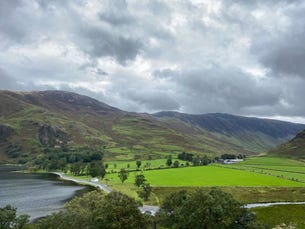
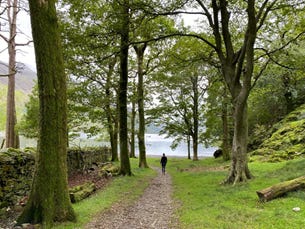
The gaiety of the scene also seems to me to be a physical thing. I can feel the breeze, I know the temperature is not hot (springtime, breeze, cloudy, dancing waves), the scents of rural life are upon me, that mixture of natural waste, the tang of the water, the extra oxygen one seems to receive from rich grassland. The ‘margin of the bay’ along which these daffodils stretched is said to be Glencoyne Bay, a section of the edge of Ullswater. It is still a deeply rural area.
And wealth has been brought! Wealth beyond mere commercial satisfaction. This wealth is as permanent as the poet’s life is long for him; and then beyond, for ever, owing to his skill in capturing a moment which people throughout the ages of man who enjoy reflection can summon up. Who has not lain ‘in vacant or in pensive mood’, mind wandering, seeking a star perhaps, seeking a solution or a start to a journey, and enjoyed images that ‘…flash upon that inward eye/which is the bliss of solitude’ ?
‘And then my heart with pleasure fills/and dances with the daffodils.’ Just one small example of the daily millions of these moments – that morning in Leeds a few years ago when Joyce’s heart and Ian’s heart with pleasure filled, and danced with the daffodils.