
#43: The Second Coming
A favourite for many, by WB Yeats

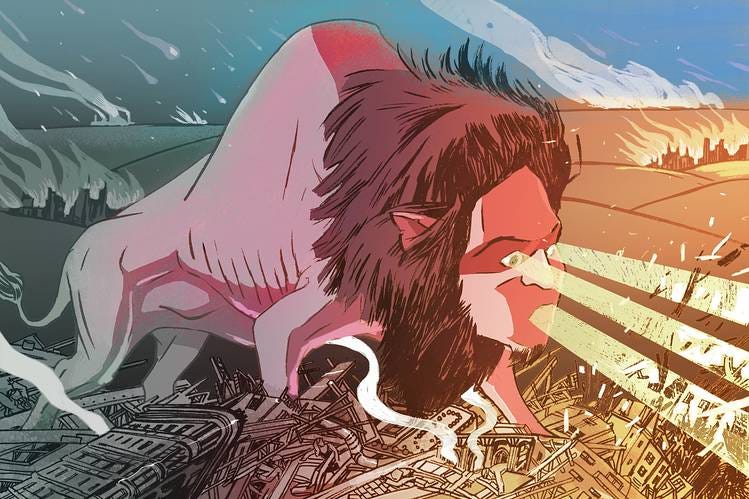
This is a remarkable poem and is justifiably renowned throughout the globe.
The Second Coming by William Butler Yeats
Turning and turning in the widening gyre
The falcon cannot hear the falconer;
Things fall apart; the centre cannot hold;
Mere anarchy is loosed upon the world,
The blood-dimmed tide is loosed, and everywhere
The ceremony of innocence is drowned;
The best lack all conviction, while the worst
Are full of passionate intensity.
Surely some revelation is at hand;
Surely the Second Coming is at hand.
The Second Coming! Hardly are those words out
When a vast image out of Spiritus Mundi
Troubles my sight: somewhere in sands of the desert
A shape with lion body and the head of a man,
A gaze blank and pitiless as the sun,
Is moving its slow thighs, while all about it
Reel shadows of the indignant desert birds.
The darkness drops again; but now I know
That twenty centuries of stony sleep
Were vexed to nightmare by a rocking cradle,
And what rough beast, its hour come round at last,
Slouches towards Bethlehem to be born?
This poem was published in 1921, moments after the end of what must have seemed at the time as apocalyptic a catastrophe as could ever befall the earth. Yeats died just before WW 2 broke out so was spared witness to an even more horrifying spectacle. But his language is everlastingly contemporary, and we use it to interpret mayhem now and probably always will.
An analysis in 2016 showed that lines from this poem were quoted more often in the first seven months of 2016 than in any of the preceding 30 years. In the context of increased terrorist violence and political turmoil in the Western world after the Brexit referendum, the election of Donald Trump as President of the United States of America, the election of Jair Bolsonaro as President of Brazil, the activist unrest in France of the ‘gilets jaune’ and many other situations of socio/politico/enviro/economic upheaval around the globe, commentators repeatedly invoked its lines: ‘Things fall apart; the centre cannot hold’.
But it is more than that one phrase; it is the whole first stanza of unparalleled written imagery. ‘Turning and turning in the widening gyre’ a falcon loses contact with its falconer. A gyre is an oceanic vortex of wind, the earth’s rotation and landmasses causing spiralling currents over vast distances. We are immediately off-balance, vaguely nauseous, lost, then: ‘Things fall apart, the centre cannot hold’. Is this the advent of the political and social extremism we are witnessing today nearly one hundred years later? Well, life has in fact been extreme all that time, just regard some of the political activists in the last century and their emblems and ideologies and followers’ language and the debris they have left behind. The next line brings the point home: ‘Mere anarchy is loosed upon the world’. I so admire the word ‘mere’ because it tells truth to anarchy – it is mere, it is easy, destruction of what went before is child’s play. How harder it is to build in the first place societies and laws and governances and police forces and schools. ‘The blood-dimmed tide is loosed’ and it drowns the ‘ceremony of innocence’; a tsunami (we know what those are now) of blood-coloured water overwhelms all things youthful, bright and beautiful. And leadership? Strength of character? Someone to link arms with and stand opposed to the declines and abuses and hatred? No, all gone, only the sycophants remain, pretending to be ‘great’ and failing even within their own times. The good guys are ‘doing an Achilles’ skulking in their tents. How long is this epoch going to last?
Is Yeats looking backwards or forwards in this poem? In stanza 1, almost certainly backwards given the awful nature of WW 1. Yet it is striking how he has picked out all the misdemeanours of interpretation and application that occurred later in the 20th century. Stanza 2 looks forward and is curiously less enigmatic, less powerful than stanza 1. He foresees a rough beast slouching towards Bethlehem to be born, a Second Coming totally off-set to expectation, and anticipating horror. We can make many parallels to ‘somewhere in sands of the desert’ but all seem to me to be out of date. How would Yeats have phrased stanza 2 today? What rough beast is slouching towards us now? How described? From a wet market in Wuhan? A valley in California? A polar ice cap? The office of a deranged political leader with his finger on a button?