
#29: Dylan Thomas
In my Craft or Sullen Art

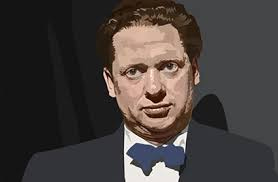
Dylan Thomas comes finally to our notice, living up to the title of this blog and showing breath-taking courage. More on this a little later. Such is the rich texture of the language used by Thomas, it is the ear that is fabulously rewarded for listening. And the brain, in the way he strings words together that have no obvious connection and yet still the meaning is clear.
Take this poem, not his most well-known, but superb in its use of language and its symbolisms.
In my craft or sullen art
Exercised in the still night
When only the moon rages
And the lovers lie abed
With all their griefs in their arms,
I labour by singing light
Not for ambition or bread
Or the strut and trade of charms
On the ivory stages
But for the common wages
Of their most secret heart.
Not for the proud man apart
From the raging moon I write
On these spindrift pages
Nor for the towering dead
With their nightingales and psalms
But for the lovers, their arms
Round the griefs of the ages,
Who pay no praise or wages
Nor heed my craft or art.
Sullen? Perhaps lacking joy? It is hard work after all for the poet, labouring at night when only the moon rages. And we know that the moon doesn’t really rage, it is the poet who does. And he does so ‘for the lovers who lie abed, their arms round the griefs of the ages’. I find myself envying the youthful lovers here, that (though I am still in love) the spontaneous and capricious recklessness of youth is mine no longer. Thomas exercises his craft not for ambition or money or recognition. No, rather for ‘the common wages of their (the lovers’) most secret heart’. What are these wages? A deep knowledge of the intimate thoughts of lovers and their griefs, the griefs of the ages, in their arms. And of course, what are the lovers really holding in their arms? Why, their lovers, of course. Loving is a state of grief for both people. Thomas knows: Here is grief, grief tremendous, lives and loves on the edge, never quite knowing if about to fall into oblivion.
And he does what he does – the poet – for these lovers in their impossible embrace for nothing! No material reward expected, no bread, no ambition, no recognition. In fact, the objects of his gaze do not heed his craft or art, do not praise him or pay him. What does he seek?
Here is the essence of the bravery of the poet. He seeks ONLY to understand the common wages of the lovers’ most secret heart, nothing more. Knowing that here he has access to the secrets of life itself. That’s all he wants – to understand the meaning of life and his place in it. The lack of self-aggrandizement of the poet is a common archetype. Poets do not generally seek ‘…ambition or bread/Or the strut and trade of charms/On the ivory stages’. They are not accustomed to performing ‘…for the proud man apart/From the raging moon…/On these spindrift pages/Nor for the towering dead/With their nightingales and psalms’. Poets and other great creative spirits seek the truth, the truth as they perceive it (their truthfulness perhaps), and to express it in their chosen medium. Vincent van Gogh has always struck me as one such brave soul, brave to the point of madness in his quest to portray his vision of colours and forms. Deliberation of these matters can unhinge even the strongest characters, and there are many such examples. As Philip Larkin says in his poem Days, such reflection will: ‘…bring the priest and the doctor/In their long coats/Running over the fields’.
So, Dylan Thomas uses the English language in an exquisite fashion, perhaps how it is meant to be used - informal or no connections, sense prevailing despite that, and overwhelming language. All directed to his relentless search for his hidden purpose, an answer to the question ‘What is going on here?’ In this world, in this life.
All the while the sound of a lilting Welsh voice whispering the poem to his love.