
#12: Inversnaid
Gerard Manley Hopkins on environmentalism

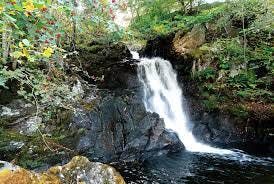
Loch Lomond, the largest loch in Scotland, is thirty miles to the north-west of Glasgow. Inversnaid, the eponymous hamlet for this week’s poem, is located on the ‘wrong’ side of Loch Lomond, the hard to visit, eastern side. On the western side are roads, golf courses, country estates, whereas opposite is dark, hilly and the land drops directly to the water. There is a hotel at the water’s side where Gerard Manley Hopkins was staying when he wrote this poem in September 1881.
This darksome burn, horseback brown,
His roll-rock highroad roaring down,
In coop and in comb the fleece of his foam
Flutes and low to the lake falls home.
A windpuff-bonnet of fáwn-fróth
Turns and twindles over the broth
Of a pool so pitch-black, féll-frówning,
It rounds and rounds Despair to drowning.
Degged with dew, dappled with dew
Are the groins of the braes that the brook treads through,
Wiry heathpacks, flitches of fern,
And the bead bonny ash that sits over the burn.
What would the world be, once bereft
Of wet and of wildness? Let them be left,
O let them be left, wildness and wet;
Long live the weeds and the wilderness yet.
This poem is among my top ten. From when I first heard Ted Hughes reciting it in his rich West Yorkshire tones, I fell in love with the energy and beauty of the words. It is a belting stream, dashing down to the loch, kicking up spume and spray that floats on the air like children’s foam bubbles. Hopkins is innovative in his use of rhythm, rhyme, alliteration and metre.
The rhythm is strong, astounding. Take those two lines: ‘Degged with dew, dappled with dew/Are the groins of the braes that the brook treads through’. Apply the stress to the first of these lines: ¯˘˘¯/¯˘˘¯ Degged with dew, dappled with dew… Listen to the effect of the repetition of the ‘d’. And then the sixfold repetition of the ‘r’ sound in the second line is one of the most famous examples of assonance in poetry. It does exactly what it is meant to do – draw attention in the reader’s mind to the power of the stream, its colour and its s-like, groiny course through the moor. The brook here is picking its way through the ‘wiry heathpacks’, the ‘flitches of fern’. The ground about is degged and dappled with dew. There are no other known usages of the word ‘degged’ in the English language. Hopkins made it up! But how well one gets the picture – the land is boggy, dewy, probably springy, and there is that dampness that soaks right through to the bone. And the word twindle in verse two, line two? The sense suggests a spinning, perhaps a twinkling. The dictionary only knows ‘marijuana, or a twin’! I have a feeling that if we think too deeply about this language, its effect is reduced. Rather simply say it or read it – and let one’s imagination run riot!
‘Of a pool so pitch-black, féll-frówning, /It rounds and rounds Despair to drowning’. This pool is so black it would cause even the personification of Despair to commit suicide. The poet may have known deep despair in his life.
And then the remarkable last verse! Hopkins foresees environmentalism by roughly one hundred years! The following is the first line of a synopsis of the birth of the word ‘Green’ as applied to environmental topics:
The term green economy was first coined in a pioneering 1989 report for the Government of the United Kingdom by a group of leading environmental economists, entitled Blueprint for a Green Economy.
What world will we live in if bereft of wilderness? Of wildness and wetness? How prescient of a Classics school teacher to predict the gripping concerns we have today – almost one hundred and forty years later – regarding climate change and its impact on all societies. I often think the Green Party in all its global manifestations should adopt these lines as a totem.